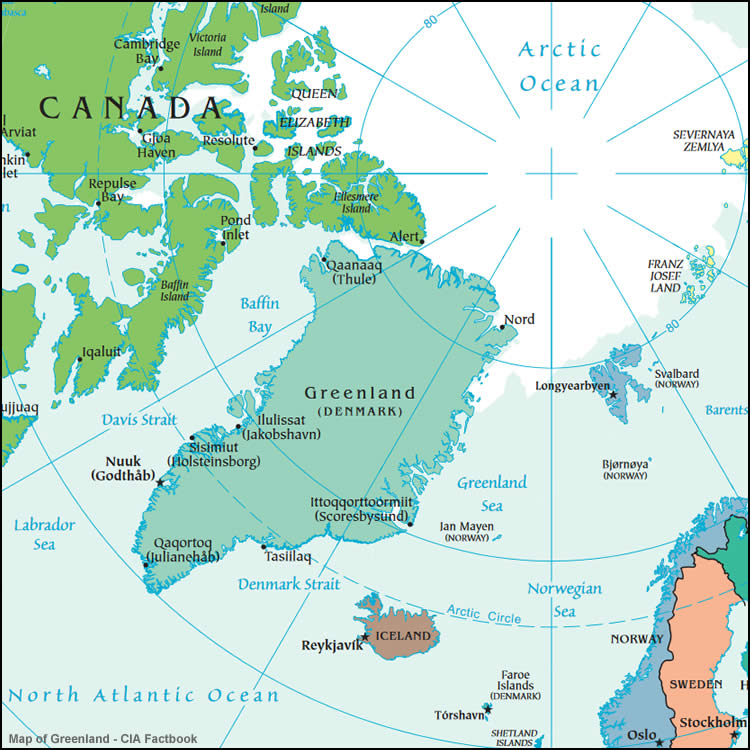
Greenland
The world’s largest island is known for its immense glaciers.
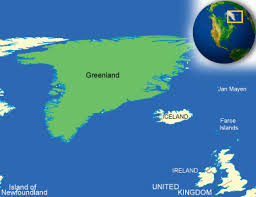
GEOGRAPHY
Located in the North Atlantic Ocean, Greenland is the world’s largest island. The island – a territory of Denmark – is more than three times the size of the state of Texas. Its nearest neighbour is Canada’s Ellesmere Island, which is located 16 miles (26 kilometers) to the north of Greenland. Iceland is its nearest European neighbour, and is located about 200 miles (about 321 kilometers) to the southeast.
Two-thirds of Greenland lies above the Arctic Circle, creating frigid climate year-round. Greenlanders experience 24 hours of sunlight in the summer, with temperatures only reaching about about 4°C, and almost complete darkness in the winter, when temperatures dip as low as minus about minus 34°C.
The Arctic climate sustains the island’s massive ice sheet, or large mass of glacier ice, which covers about 80 percent of the island. The Greenland Ice Sheet is the second largest in the world after the Antarctic Ice Sheet – it stretches over 1,500 miles (2,400 kilometers) from north to south and is nearly 1,524 meters thick in many places. That means the ice sheet is almost one mile thick in some spots!
NATURE
Greenland’s natural environment is shaped by the extreme Arctic climate. Most of the vegetation on the island exists on the tundra, away from the ice sheets. Low-growing plants like dwarf birch and whortleberry, as well as mosses and lichens, can be found throughout the tundra.
Many marine mammals live in the seas around the island, including seals, walruses, and whales. Polar bears, arctic foxes, wolves, reindeer, and musk oxen can be found roaming the island’s ice sheets. The coastal area also attracts some 230 bird species, including sea eagles, that feed on saltwater fish like salmon, flounder, and halibut.
Nearly half of Greenland is protected as the National Park of Greenland – Greenland’s only national park, and the world’s largest national park. At 971,245 square kilometers, the park covers most of the northeastern section of the island. The few people who regularly access the park are sealers and whalers from Ittoqqortoormiit, a remote town in eastern Greenland, plus a few scientific researchers and military personnel.
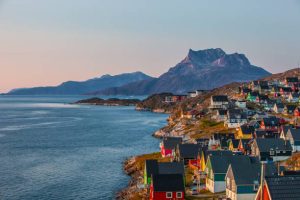
PEOPLE and CULTURE
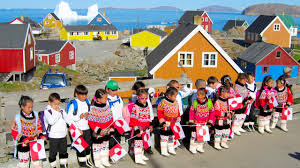
Nine out of 10 Greenlanders are of Inuit descent, and the remainder of the population are Danish or European. The majority of people in the territory live in one of the island’s 18 cities, including the its capital, Nuuk, located on the southwest coast.
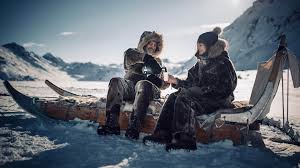
Greenlandic culture is influenced by Inuit traditions. Hunting and fishing remain a way of life on the island, and many Greenlanders still use traditional tools and hunting methods, such as the qajaq (a sea kayak) and ulo (a curved knife used to carve seal meat). They also often travel by dogsled.
Traditional Inuit cultural activities like soapstone carving and drum dancing are still popular on the island, as are sports. Soccer is one of the most popular sports in Greenland, along with volleyball, table tennis, and skiing.
MINERALS
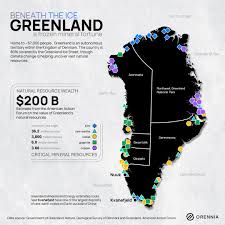
Greenland holds significant subsoil mineral wealth, including abundant rare earth elements (REEs), graphite, lithium, iron ore, zinc, lead, gold, diamonds, uranium, and oil/gas, crucial for green energy tech and defence, with mining ambitions focused on self-sufficiency despite challenges from ice cover and environmental concerns, even as some mining (like uranium) is restricted**. Key deposits include Kvanefjeld for REEs, Amitsoq for graphite, and various West Greenland sites for nickel-copper-cobalt.
- Rare Earth Elements (REEs): Greenland has major REE deposits vital for electronics, EVs, and wind turbines, with significant potential at sites like Kvanefjeld.
- Graphite: Large Amitsoq deposit, essential for batteries, but extraction faces challenges.
- Lithium: Deposits present, critical for batteries.
- Iron Ore, Zinc, Lead: Traditional commodities with known deposits.
- Gold & Diamonds: Present in various regions, with Nalunaq mine for gold.
- Uranium: Deposits exist but exploitation is currently banned.
- Oil & Gas: Potential reserves exist offshore, though exploration has faced difficulties.
- Other Minerals: Copper, tungsten, palladium, vanadium, titanium, and platinum group metals are also present.
Bibliography: Wikipedia, National Geographic Greenland, Valleret blog, Google AI, Fiftydegrees north,com, Alamy.com, Orennia.com.
text by Martinho Ferreira
January 2026
Good work, Martinho.
Great work Martinho, and thank you for posting José Silva.
Awsome. Tkanks for sharing.
Thank you so much for this really good work, for the knowledge shown, and how actual is the subject.
Congratulations Martinho.
Very well, and thanks Martinho and José Silva.
O really liked to read this text Martinho.
Thanks for your work.
Thank you, Martinho, for the excellent work. Now I understand the interest in Greenland better.
Thank you, Martinho.
You did a very interesting and up-to-date piece of work. I learned more about Greenland and the reason for the covetousness generated by all the wealth of those lands.
Thank you Jose Silva for the publication and as always very well done.
It was a good and in the right moment text.
Thank you to Martinho e José Silva